




Reliable Repairs for Leaking and Damaged Garage Roofs
Garage roofs are continually exposed to rain, wind, temperature changes and standing water. Over time, the roof covering can split, crack, lift at the edges or deteriorate around joints, outlets and adjoining walls.
Not every leaking garage roof needs to be completely replaced. Where the damage is localised, and the underlying roof structure remains in suitable condition, an effective repair may extend the life of the roof.
Where deterioration is widespread, the roof deck is damaged or repeated repairs are no longer providing reliable protection, replacement may offer better long-term value. Our team will explain the findings and provide a clear quotation before work begins.
Which Kind of Garage Roof Do You Have?
In short: garage roofs generally fall into one of four types, and the type largely decides which repairs make sense.
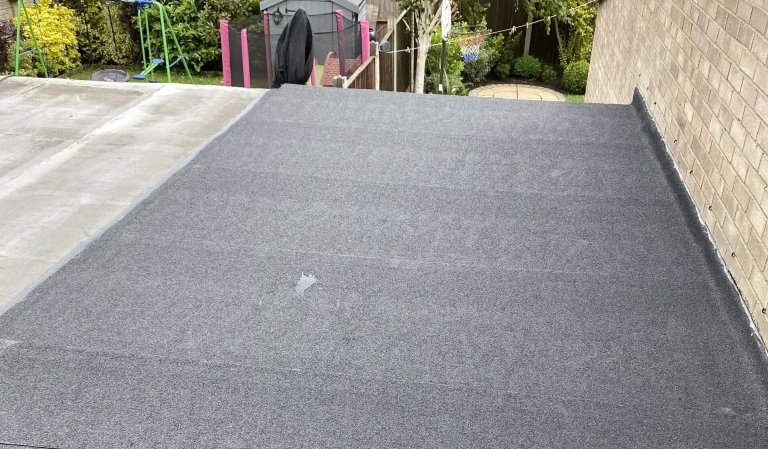
- Brick or block garage with a flat roof: timber joists and a boarded deck, finished with felt, EPDM or GRP.
- Prefabricated concrete garage: sectional concrete panels carrying a lightweight sheet roof, often corrugated fibre cement or profiled metal. Re-roofing usually means new sheets rather than piecemeal patching.
- Pitched garage roof: tiles or slates on timber rafters, often matching the house. Slipped tiles or a loose ridge are repaired much as on the main house; see our roof repairs page.
- Attached garage or lean-to: a flat or mono-pitch roof that meets the house wall, where the junction is often the weak point.
On attached garages, water can enter at the wall junction even when the covering is sound. Rain soaking into the house wall above can run down inside the cavity and emerge at roof level unless a cavity tray directs it outwards, and some older houses do not have one. We check the wall and lead flashing as well as the roof. While you wait for a repair, our article on garage flat roof leaks has some safe, temporary measures.
Sheet Roofs, Fragile Surfaces and Asbestos
Corrugated fibre cement sheets on older garages are classed as fragile and can give way under a person’s weight, so they should never be stood on.
Asbestos cement was widely used for garage roof sheets until asbestos was banned in the UK in 1999, so a garage built or re-roofed before 2000 may contain it. Sheets in good condition that are left alone are generally considered low risk, but they should not be pressure-washed, scrubbed or broken up. A sample can be tested before any work is planned, and where asbestos is confirmed, removal and disposal must be carried out by suitably trained people under the Control of Asbestos Regulations 2012. We will explain what that means before quoting for the new roof.
When the Garage Is More Than a Store
A garage used as a gym, workshop or home office needs more from its roof than one that only shelters a car. If the space will be heated, a warm roof, with insulation fixed above the deck beneath the new covering, keeps the timbers dry and the room more comfortable. Converting a garage into a habitable room normally needs Building Regulations approval, with the roof, walls and floor all brought up to insulation standards. Our team can handle the roof alongside the wider building work involved.
Unheated garages with metal sheet roofs can also drip with condensation in cold weather; sheets with an anti-condensation backing can reduce this.