




Emergency Roofer in Aintree
Roofing problems do not always happen at a convenient time. Heavy rain, strong winds and sudden roof damage can result in active leaks, slipped tiles, missing slates and water entering your property.
Our emergency roofing service covers Aintree, providing assistance for urgent roofing problems that require prompt attention.
Where weather conditions and safe access allow, our roofers can assess the affected area and undertake suitable temporary or permanent repair work.
If your roof has suffered sudden damage or water is actively entering your property, call our team on 0151 739 0669.
About Aintree
Aintree is known around the world as the home of the Grand National and Aintree Racecourse. The famous racecourse has played a major part in putting the area on the map, particularly during the annual Grand National meeting.
Away from the racecourse, Aintree is a busy residential and commercial area. The A59 runs through the local area, with Racecourse Retail Park and a wide range of homes and properties surrounding Aintree Village.
Aintree Lane and Melling Road are also familiar local routes. Melling Road famously crosses the racecourse itself and forms part of the Grand National course.
For those living and working locally, Aintree is much more than race day. It is an established part of the wider Liverpool and Merseyside area and one we regularly cover for roofing and building work.
How Aintree Village and Old Roan Grew
Most homes in Aintree are semi-detached houses built between the 1930s and the early 1970s, with a few far older cottages and some newer infill. Because so many went up in the same decades, roofs on the same road often need similar work at around the same time.
Aintree stayed a small rural village into the early twentieth century. In the 1920s the British Enka artificial silk works opened, and the first new houses were built for its workers near the Blue Anchor. From the 1930s onwards, much of what is now Aintree Village was built up with semi-detached houses, new roads and shopping parades. To the north, new housing on former farmland at Old Roan led to a station opening there in 1936.
A few much older buildings survive. The Grade II listed late eighteenth-century houses at Mill Square are brick with stone slate roofs, a heavy traditional covering that is best repaired with matching reclaimed stone.
Typical Roof Problems on Aintree's Semis
Semis from this period were soundly built, but even the newest are now around fifty years old. The faults we come across most often are:
- Missing or perished underlay. Some pre-war roofs were laid with no underlay at all, relying on the tiles alone, and early felt underlays perish over the decades, so wind-driven rain that gets past a tile has nothing to stop it.
- Tired hips and ridges. Hipped roofs are common here, and where hip and ridge tiles sit on mortar alone, the bedding eventually breaks up and the tiles start to rock.
- Bay window roofs. The small lead, felt or tiled roofs over bays are a frequent cause of damp around front windows.
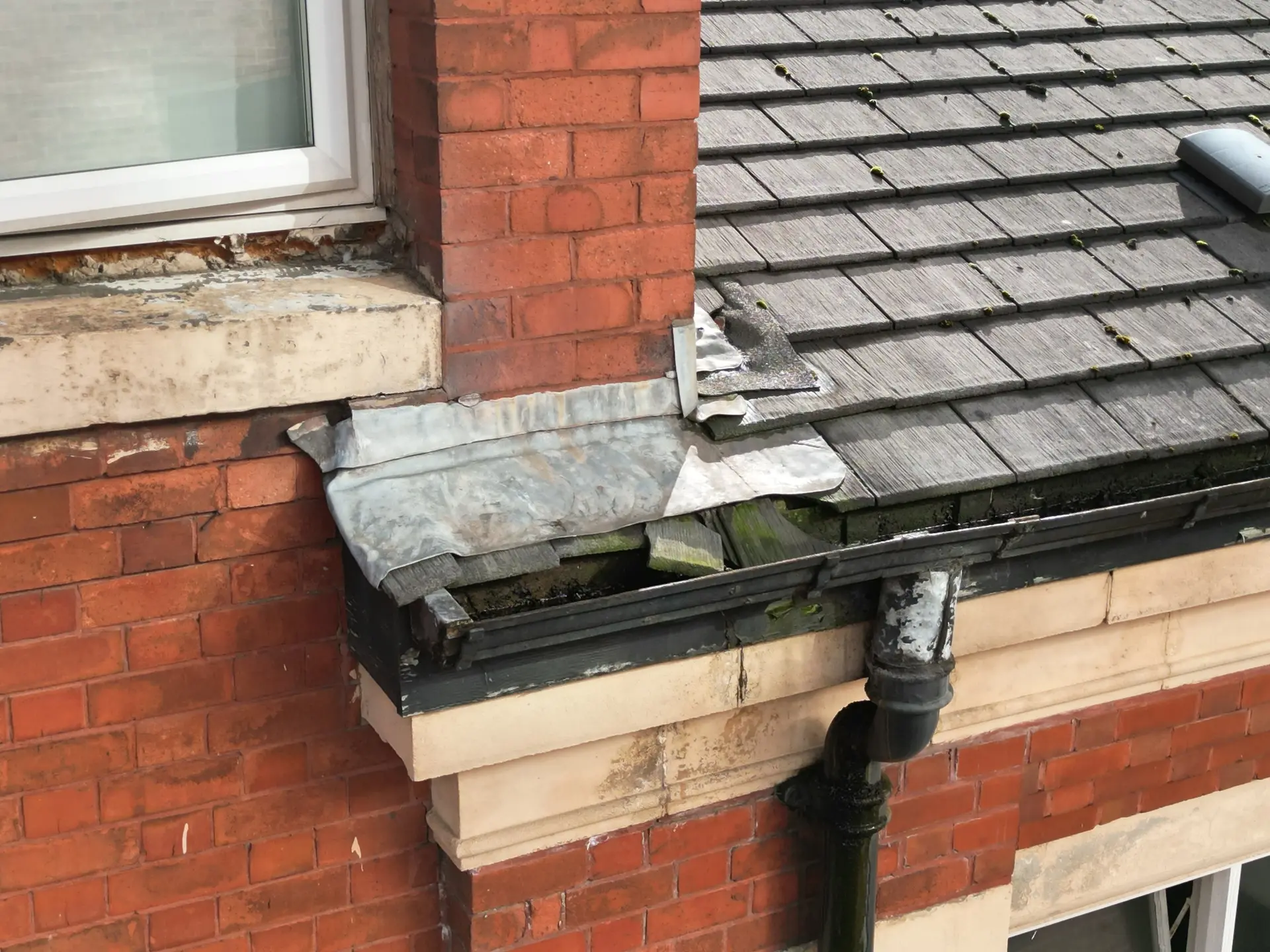
- Chimney stacks. Water gets into chimney breasts through split flaunching, worn leadwork and pots that have worked loose. Our chimney repairs deal with all three, and disused stacks can be capped and ventilated.
- Garage and porch roofs. Flat roofs added over the years often wear out before the main roof. See our garage roof page for repair and re-covering options.
If several neighbours on your road have had roof work done recently, it can be worth having yours looked at too. A roof inspection shows you what condition it is in before a leak forces the decision.
Covering Aintree from our base at Maghull Business Centre.