




Finding and Fixing the Source of Your Roof Leak
The place where water appears inside a property is not always directly beneath the point where it entered the roof. Water can travel along roof timbers, membranes, insulation and internal surfaces before it becomes visible.
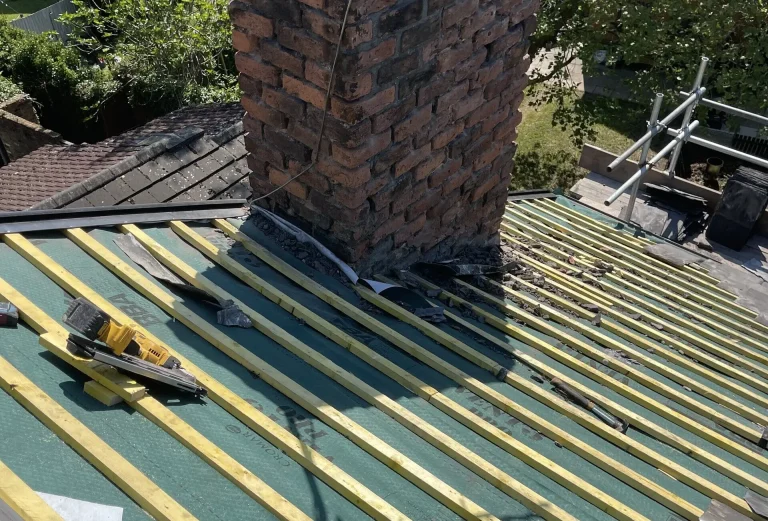
Our roofers assess the affected area and examine common entry points, including tiles, slates, valleys, chimney junctions, lead flashing, flat roof coverings, roof windows and rainwater systems.
Once we have identified the likely cause, we will explain the available repair options and provide a clear quotation for the work required.
Where Roof Leaks Really Come From
In short: the stain on your ceiling marks where the water finished, not where it started. Most leaks begin higher up the roof, at a flashing, valley, slipped tile or joint, and tracing a leak means working back from the stain to that entry point before anything is repaired.
Where the damp shows tells us where to start looking:
| Where the damp shows | Common sources to check |
|---|---|
| Ceiling or wall beside a chimney breast | Lead flashings and soakers, the back gutter behind the stack, cracked flaunching, porous brickwork, or rain falling down an uncapped flue |
| Along the top of an outside wall, near the eaves | Perished felt at the eaves, slipped tiles on the bottom courses, or gutters overflowing back towards the wall |
| Where two roof slopes meet, or below a dormer | Blocked or split valleys, failed side flashings, and cut tiles that have slipped |
| Around a roof window | A damaged flashing kit, debris built up above the window, or condensation running off the glass |
| Under a flat roof | Splits, failed joints, lifted edge trims, worn upstands where the roof meets a wall, or a leaking outlet, often some distance from the stain |
| Near a bathroom or soil pipe | The seal around a vent pipe where it passes through the roof, or a plumbing leak rather than the roof |
| Only in wind-driven rain | Verges, the slope or gable facing the wind, flashings on that side, and porous gable brickwork |
How We Trace a Roof Leak
Leak tracing is a process of narrowing down. It starts with what you have noticed: whether the damp appears in every shower or only in prolonged heavy rain, whether it follows wind from one direction, and how soon it shows after the rain starts. Water that appears within minutes often points to an open gap, while damp that shows hours later, or only after days of wet weather, suggests water soaking through slowly or travelling a long way first.
Where the loft is accessible, it often holds the answer. Water leaves tide marks on rafters, dark patches on the felt, rusty nail heads and stained insulation, and following those marks upwards leads to the highest point where the timber is wet. We then check the outside of the roof above that point, along with anything further up the slope that could be feeding it.
We also rule out causes that are not the roof at all, such as a leaking pipe or tank in the loft, a failed seal around a window, or rain soaking through a porous wall. If the source is still unclear, wetting one area of the roof at a time while someone watches from inside can confirm the entry point. Our guides to detecting hidden roof leaks and the early signs of a roof leak explain what you can look out for yourself.