




Professional Slate Roofing for Your Property
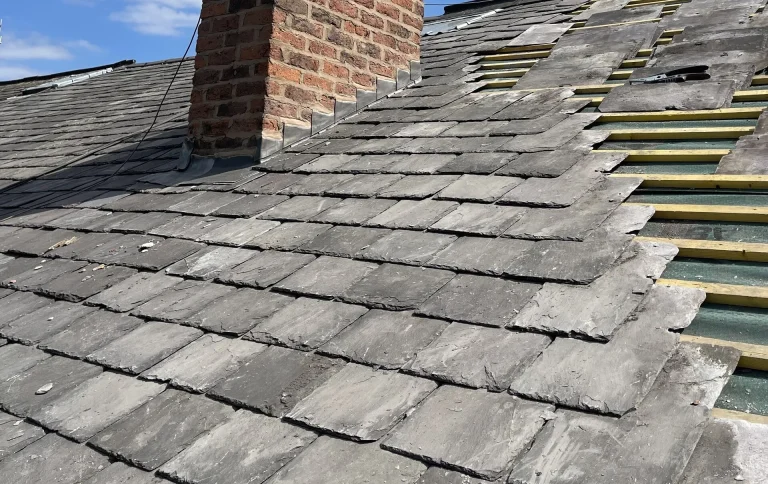
Slate roofs can develop problems because of weather exposure, ageing fixings, damaged battens, previous repairs or movement within the roof structure. Even one missing or broken slate can leave the materials beneath exposed to rain.
Where the problem is localised, replacing damaged slates and addressing the underlying cause may restore the roof without extensive work. Where deterioration is more widespread, partial restoration or a complete re-roof may provide a more reliable long-term solution.
Our team can assess the condition of the slates, fixings, battens, underlay, ridges, valleys and adjoining leadwork before recommending the appropriate work.
Choosing the Right Slate for Your Roof
In short: natural slate gives the most traditional finish. Welsh slate is the historic choice on many period homes across Merseyside, and Spanish slate is the most common natural alternative today. Reclaimed slate helps to match older roofs, while fibre-cement and other man-made slates are lighter and more uniform but look flatter.
| Slate type | In its favour | Things to weigh up |
|---|---|---|
| Natural Welsh slate | The original covering on many Victorian and Edwardian homes in the region, with a long track record and blue-grey to heather tones | Usually the most expensive option |
| Natural Spanish slate | Widely available in many sizes and grades, at a lower cost than Welsh slate | Quality varies between quarries and grades; some slates contain iron pyrite that can rust and stain |
| Reclaimed slate | Can match the size, colour and weathered look of an existing roof, which helps with repairs and partial renewal | Supply varies, slates must be sorted for size, thickness and soundness, and their remaining life is harder to judge |
| Fibre-cement slate | Lightweight, uniform in size and quick to lay, usually at a lower material cost | A flatter, more regular look than natural slate; the colour can soften over time, and fixing usually includes a disc rivet at the tail |
| Other man-made slates | Composite, recycled and slate-effect products offer lighter or lower-cost alternatives | Appearance and performance vary widely between products, so check suitability before using them on a period street |
Natural roofing slate is tested to the European standard BS EN 12326, so when comparing quotes it is reasonable to ask which slate, grade and quarry is being proposed. Our article on questions to ask slate roofers suggests others worth asking.
Older Slate Roofs Without Felt
Many Victorian and Edwardian slate roofs were built with no felt under the slates. Instead, the undersides were sometimes pointed with lime mortar, known as torching, to cut draughts and steady the slates. If you can see the backs of the slates from the loft, perhaps with crumbling mortar between the battens, that is what you are looking at. It is not a fault in itself, but there is no second layer to catch water if a slate slips or cracks.
Spraying foam onto the underside of the slates is sometimes offered as a way to stop them slipping. We would not recommend it. Foam can trap moisture against the battens and rafters, hides their condition, and makes later repairs and the reuse of slates much harder. Refixing the slates, or re-slating where the nails have failed across the roof, deals with the actual cause.
Slate on Terraces and in Conservation Areas
On a terraced street, each roof is read as part of one long slope. A single house re-covered in a noticeably different slate, size or colour tends to stand out, and the joint with the neighbouring roof at the party wall needs careful detailing so water cannot get in between the two.
Listed buildings need consent for alterations that affect their character, which can include re-roofing, and in conservation areas councils often look for natural slate to stay natural slate. Some conservation areas also have an Article 4 direction, under which a change of roofing material that would normally be allowed needs planning permission.